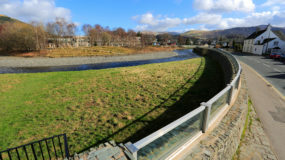
The Environment Agency is delivering a proposed Flood Risk Management Scheme to better protect homes, businesses and communities from flooding across the Kent catchment, while improving the local environment and community amenities.
Kendal Town is the first area to be delivered, with the upstream communities of Burneside, Staveley and Ings, including flood storage, forming later stages of the scheme. In addition, Natural Flood Management measures are being integrated into the plans which help slow the flow of water, store water in the landscape, improve habitats and biodiversity, whilst providing wider environmental benefits across the catchment.
Please scroll down for further information.

Upstream measures are an essential part of the Flood Risk Management Scheme and support the Environment Agency’s aim to provide a 1% AEP (Annual Exceedance Probability), which aims to provide a 1 in 100‑year standard of protection for homes and businesses across the Kent catchment.
The scheme is being delivered using an adaptive pathway approach. This means work is planned in phases that can evolve over time, allowing investment to be directed where it will have the most benefit. Decisions are guided by the latest climate science, environmental evidence, and funding availability, helping the scheme stay flexible and resilient as conditions change.
This approach also allows the scheme to respond to new opportunities — for example, progress on upstream measures, innovation in nature‑based solutions, or changes in community needs. By building flexibility into the programme, the Environment Agency can keep momentum on priority work while ensuring the overall scheme remains technically robust, financially responsible, and environmentally sustainable.
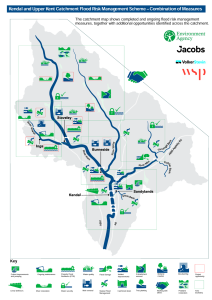
Click the image to view a larger version
A combination of upstream interventions will work together to reduce flood risk for communities downstream. These include:
Working as a standalone option, NFM cannot provide the level of protection required across the Kent catchment, due to limitations such as volume of water storage required, land availability and the scale of land‑use change needed.
However, as part of a package of measures, NFM offers significant benefits. By working with natural features across the catchment, it helps to slow the flow and increase water stored in the landscape.
NFM methods improve river and habitat biodiversity, support climate resilience, and help deliver environmental enhancements across the catchment.
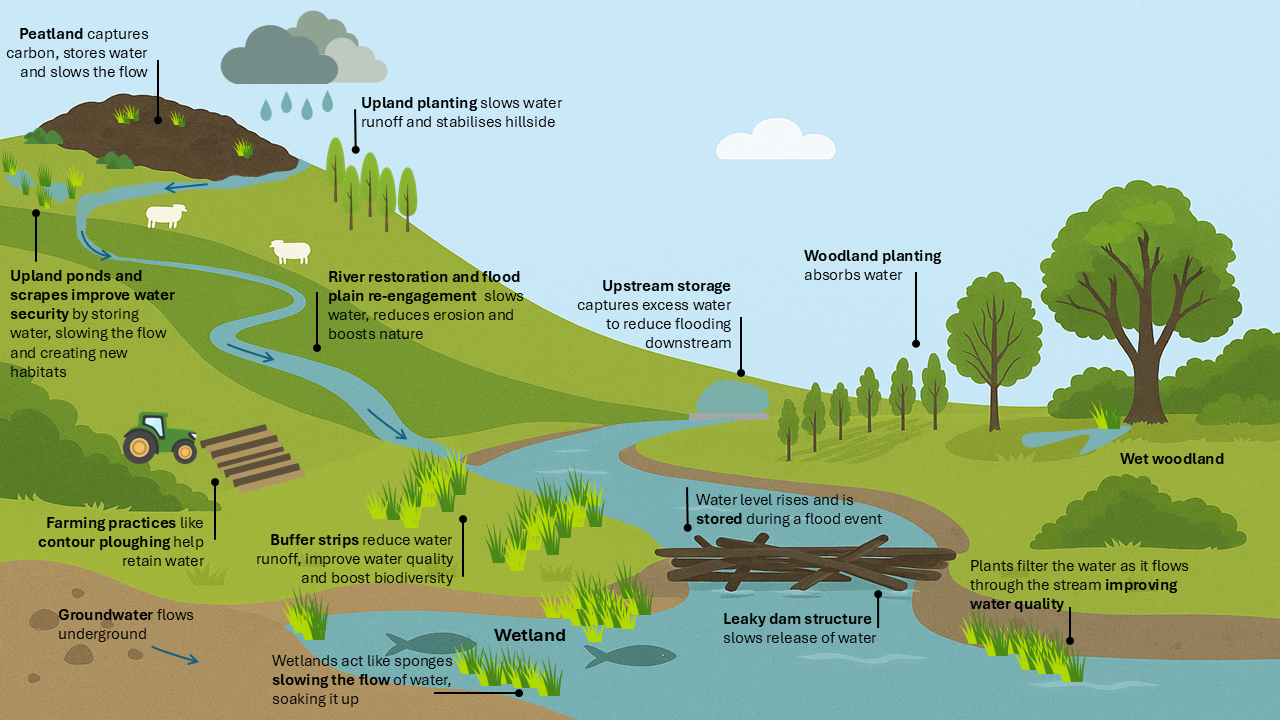
Click the image to view a larger version
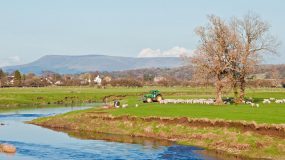
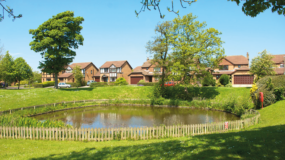
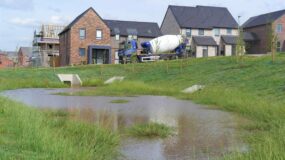
Flood storage areas are designed to blend into the landscape as far as possible. They typically use earth embankments and a control structure to temporarily hold water during extreme storms. In normal conditions, the land continues to be used as it is today — the storage area only fills during major flood events.
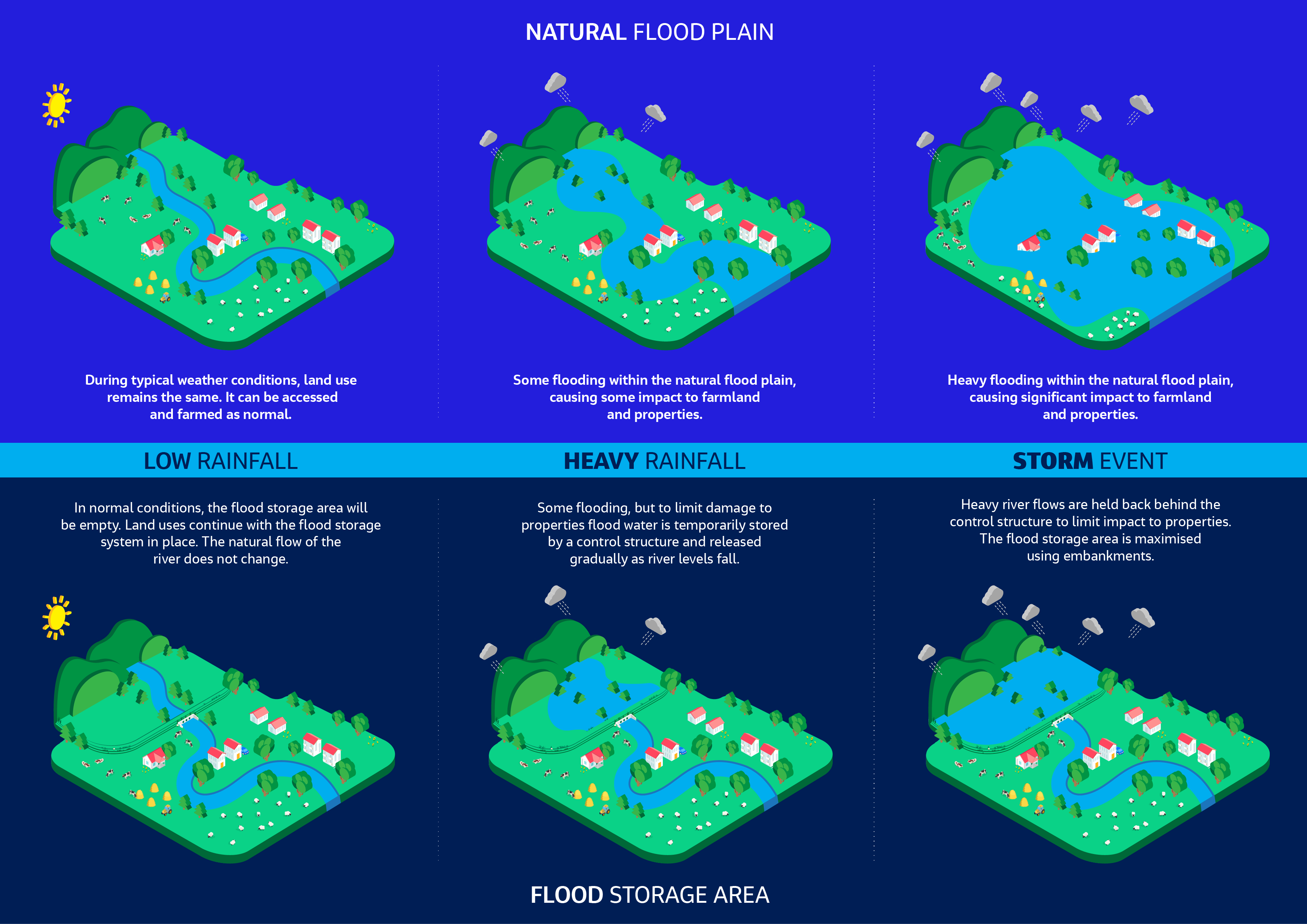
Click the image to view a larger version
Before any design is confirmed, engineers carry out detailed ground investigations and surveys to understand how the land behaves — from groundwater movement to soil and bedrock composition. These studies ensure any storage area is safe, effective and environmentally responsible.
Flood storage design must meet strict national standards, including the Reservoirs Act 1975, Eurocodes and British Standards. These ensure any structure is built safely and to the highest technical standard.
Click here to read more.
Ivy Bridge is a Grade II listed structure; however, it was badly damaged during Storm Desmond and is now structurally compromised. The Environment Agency will continue to work closely with Historic England to understand the options and agree the best approach for its future.
Any proposed flood storage area will be designed and landscaped to fit naturally within its surroundings as far as possible. All tributaries of the River Kent are ecologically important systems, and the Environment Agency is working with partners to ensure that flood storage and wider measures, not only reduce risk, but also enhance habitats and support wildlife across the upper catchment.
The Environment Agency are following a step-by-step process – from ground investigations and surveys through design development, planning and construction – to make sure the flood storage area is carefully designed, integrates effectively with the wider scheme, and is delivered with the community and environment in mind. The Environment Agency will continue to work with landowners, stakeholders and the community at every stage in the process.
Click here to find out more on the ‘What’s Happening?’ page.
The Environment Agency’s key tests are used to determine whether a flood risk management scheme – as well as each individual measure – is economically viable, technically feasible, environmentally sustainable, socially acceptable and safe to deliver. Applying these tests enables the Environment Agency to design solutions that provide an improved standard of protection, delivered in the right place, at the right time.
In combination with the proposed flood storage area at Ivy Bridge, for the upstream communities of Burneside, Staveley and Ings, the results of the mini assessments and economic reviews demonstrated a need for a bespoke approach to flood risk management for each village.
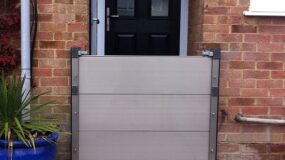
Rather than relying solely on traditional hard‑engineered defences, the assessments showed clear opportunities to explore a mix of tailored solutions, including:
This combination of measures aims to deliver bespoke schemes shaped around need, characteristics and community priorities.
The Environment Agency are committed to working with a wide range of landowners, organisations and local partners to bring forward projects that improve biodiversity, restore habitats, infrastructure, river conveyance and help manage flood risk across the catchment. Varying in scale and focus, this could include restoring watercourses and wetlands, deliver natural flood management measures, and improve biodiversity.
The Environment Agency are keen to work with others to explore new opportunities, if you’re interested in developing a project or discussing opportunities to work together, they’d love to hear from you.
Click the image to view a larger version
Building on the Adaptive Pathway approach, the Environment Agency is working with landowners and partners across the catchment to deliver and support a wide range of Natural Flood Management (NFM) and environmental projects.
These solutions will help manage flood risk in a changing climate while creating opportunities to enhance habitats, improve water quality and support local wildlife. This collaborative approach aims to build a long‑lasting, climate‑ready and a sustainable future for communities and the environment.
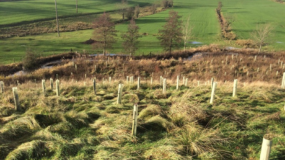
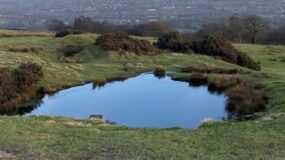
NFM focuses on working with natural processes to slow, store and filter water. Typical measures include tree planting, leaky dams, soil and land management and wetland creation, all designed primarily to reduce flood risk.
The Environment Agency aim to build on these techniques, combining traditional NFM with minimal engineered solutions and environmental improvements to deliver additional benefits, that go beyond flood mitigation through the scheme.
These projects may include habitat and river restoration, peatland and landscape recovery, floodplain reconnection, carbon storage and water‑quality enhancements. Together, they support biodiversity, strengthen climate resilience and help restore natural ecosystems, while contributing to effective flood management.
Click here to find out more on the ‘What’s Happening?’ page.
Click here to view a larger version