This blog has been written by The Flood Hub People.
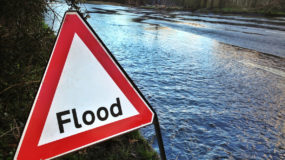
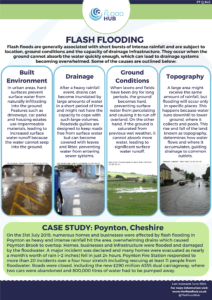
Flash flooding can strike suddenly, often affecting communities due to very localised and intense rainfall. These unpredictable events can have devastating consequences for homes, businesses and infrastructure.
Even if you don’t live or work in a designated flood risk zone for main rivers, you could still be affected by flash flooding from other sources. These events are particularly challenging to predict because they are often caused by overwhelmed local drainage systems, rapid surface water runoff from hard, dry ground, or small watercourses that respond quickly to rainfall. Unlike river flooding, flash flooding may not be monitored by the Environment Agency’s Flood Warning Service, meaning some communities may receive little to no warning, leaving little time to prepare.
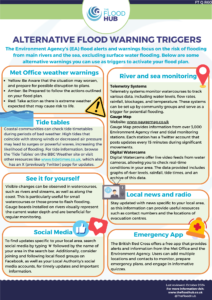
If you live in an area not covered by the Environment Agency’s Flood Warning Service, other sources of alerts can provide early notice. The Met Office Weather Warning Service and local river monitoring stations may offer some forewarning of potential flash floods. However, not all areas have river-level monitoring and in narrow channels, sudden localised rainfall can overwhelm waterways quickly, giving residents very little time to respond.
The Met Office can issue weather warnings up to seven days in advance for wind, snow, lightning, ice, extreme heat, fog, rain, and thunderstorms, the latter two being key triggers for flash flooding. Warnings are classified as yellow, amber, or red, depending on severity and potential impacts. However, these warnings often cover large areas, so they may not identify specific locations that are most at risk.
To find out more about alternative flood warnings, click here to download our resource.
Poynton, Cheshire (July 2019)
Heavy rainfall overwhelmed drains, causing Poynton Brook to overtop. Homes, businesses and infrastructure were flooded, prompting a major incident and evacuations. Around 2 inches of rain fell in just 24 hours, with the fire service responding to over 20 incidents, including rescuing 11 people from flood water.
North Yorkshire (July 2019)
A month’s worth of rain fell in just four hours, leading to widespread damage to homes, businesses and infrastructure. Livestock and pets were lost, and Grinton Moor Bridge collapsed, making the road impassable.
Galgate, Lancashire (November 2017)
Torrential rain caused the River Conder to breach its banks, flooding around 100 homes. The event was the heaviest rainfall recorded in over 50 years at nearby monitoring stations. For many residents, this was their first experience of flooding.
Millom, Cumbria (September 2017)
Over 1,000 residents in 317 properties were affected by surface water flooding after heavy localised rainfall. The town was isolated due to having only one main road in and out, but the community came together and is now working on a resilience plan.
Coverack, Cornwall (July 2017)
Localised thunderstorms caused rapid runoff from higher ground, overwhelming drains and becks. Around 50 properties were affected as surface water cascaded down the hillside.
Boscastle, Cornwall (August 2004)
A small, steep river flowing through the village was overwhelmed after eight hours of heavy rain, flooding 58 properties. The event caused extensive damage, washing cars out to sea and leaving millions of pounds in losses.
These examples highlight why having a flood plan or emergency plan in place is crucial. Flash flooding can impact areas outside of designated flood zones and the effects can be sudden and severe.
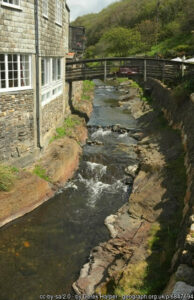
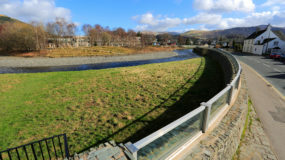
River Valency, Boscastle cc-by-sa/2.0 – © Derek Harper – geograph.org.uk/p/6847694
A common misconception is that flooding only occurs in winter. Flash flooding can happen at any time of year, including summer. Dry, compacted ground during warmer months reduces water infiltration, leading to rapid surface water runoff and increased flood risk.
If you want to find out more about the misconceptions surrounding flooding, download our resource here.

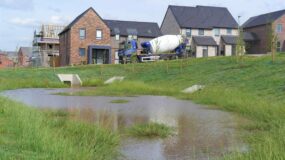
Local topography and river basin characteristics also influence flash flooding. Narrow or rounded basins can funnel water quickly into rivers, increasing discharge. Urban areas with impermeable surfaces and limited green space are especially vulnerable, as surface water cannot soak into the ground efficiently.
Click here to download the flash flooding resource.
Sources: JBA Risk Management, Met Office, .GOV.UK